The Future of Personalized Gut Care: AI-Driven Protocols for Revolutionary Healing
Introduction
In recent years, the importance of gut health has surged to prominence, with growing evidence suggesting a profound connection between our gut microbiome and overall health. The trillions of bacteria residing in our intestines play a crucial role in digestion, immunity, and mental health. An imbalanced gut microbiota has been linked to various ailments, from inflammatory bowel disease and obesity to depression and autism.
### Expanding on Gut Health Importance
Understanding the *gut microbiome’s* role is crucial because these trillions of microorganisms contribute to essential bodily functions. They aid in metabolizing nutrients from our diet, fighting off harmful pathogens, and communicating with the immune system to regulate inflammation and response to diseases. Disruption in this delicate balance can lead to chronic health issues, emphasizing the vital role gut health plays in our overall wellbeing.
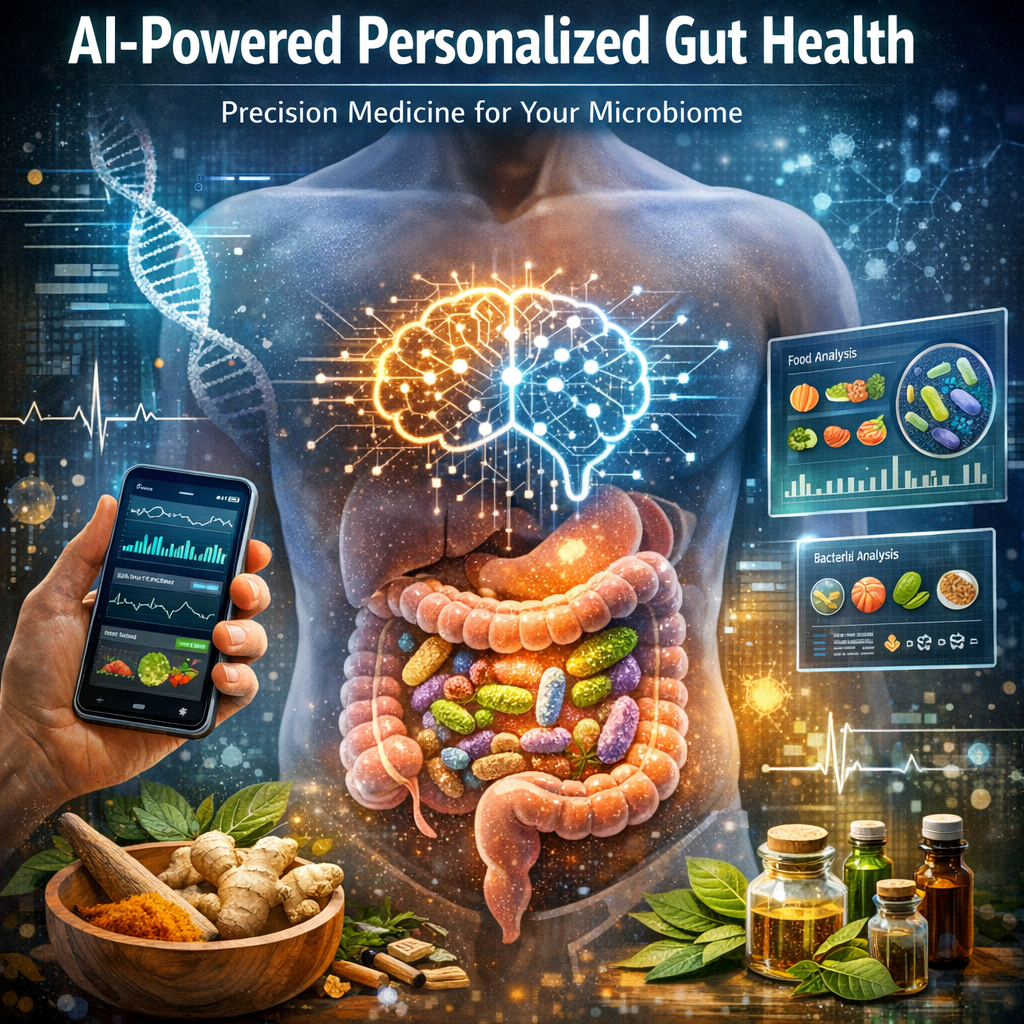
As our understanding of the gut ecosystem evolves, so too does the technology aimed at optimizing its health. Enter artificial intelligence (AI)—a transformative force in modern medicine that promises to revolutionize personalized gut care. AI-driven protocols utilize massive data sets, advanced algorithms, and machine learning to offer unprecedented insights into individual gut health patterns. This advancement makes it possible to tailor interventions with a precision that was unimaginable just a few years ago.
Imagine a world where your gut health is monitored in real-time, and personalized recommendations are sent straight to your smartphone. These recommendations might include dietary modifications, specific probiotics tailored to your unique microbiota, or herbal treatments that have been identified as optimal for your genetic makeup and lifestyle.
AI’s role in gut health isn’t limited to personalization. It’s also accelerating research, enabling clinicians and researchers to identify new correlations and causations more swiftly. For example, AI is helping to discover new probiotic strains that can target specific health issues, enhancing our ability to harness natural cures quite effectively.
Moreover, AI-driven gut protocols are not distant dreams but are becoming a reality as companies invest more in research and development. These protocols have the potential to reduce healthcare costs, as preventive care could diminish the occurrence of gut-related diseases requiring expensive treatments.
Features
One of the most compelling aspects of this movement is the growing body of research supporting AI’s role in revolutionizing gut health treatments. A study published in *Nature Medicine* revealed that machine learning algorithms could predict an individual’s response to certain diets with remarkable accuracy by analyzing their gut microbiome composition. This application allows for precision medicine that guides dietary interventions and significantly enhances treatment outcomes [1](https://www.nature.com/articles/nature14297).
Another groundbreaking study from *Cell Host & Microbe* involved AI models predicting how different bacterial strains affect the human gut. The research points to the potential of AI in speeding the identification of beneficial bacteria that could treat specific conditions, such as IBS or lactose intolerance, through personalized probiotics [2](https://www.cell.com/cell-host-microbe/fulltext/S1931-3128(14)00200-8).
AI is also making strides in analyzing lifestyle factors correlated with gut health. From examining how stress impacts the gut-brain axis to understanding the sleep-gut connection, AI is helping to uncover critical insights that guide holistic treatment plans. For instance, a study in *Frontiers in Medicine* demonstrated the use of AI in assessing how psychological stressors alter gut microbiota, highlighting the potential for integrative treatment involving herbal anxiolytics, dietary changes, and stress management [3](https://www.frontiersin.org/articles/10.3389/fmed.2020.00181/full).
The integration of AI with traditional herbal medicine is particularly intriguing. Phytochemicals in herbs like ginger, turmeric, and peppermint have long been known to aid digestion and soothe the gut lining [4](https://onlinelibrary.wiley.com/doi/full/10.1046/j.1365-2036.2001.00979.x). Through AI, researchers aim to understand better which individuals might benefit the most from these treatments based on genetic markers and gut biome analysis.
These studies underscore that AI not only enhances our understanding of the gut but also bridges the gap between technology and traditional healing practices, offering a powerful, synergistic approach to gut health.
Conclusion
As AI continues to evolve, its applications in personalized gut care promise revolutionary advancements in health and wellness. By harnessing the power of AI-driven protocols, we can embrace a future where personalized medicine is no longer a luxury but a standard. This future holds the promise of more effective prevention, diagnosis, and treatment of gut-related issues through natural and herbal interventions tailored to each individual. As we stand on the brink of this exciting new era, the prospect of combining cutting-edge technology with ancient wisdom offers a holistic path to achieving and maintaining optimal gut health.
Concise Summary
The article explores the transformative impact of AI-driven protocols in personalized gut health care, highlighting its ability to tailor interventions through advanced data analysis. AI accelerates research, aids in developing precision medicine, and potentially reduces healthcare costs. It guides dietary modifications, identifies beneficial probiotics, and integrates traditional herbal treatments for individualized solutions. This synergy of AI and herbal medicine offers a path toward more effective prevention and treatment of gut-related issues, exemplifying a blend of modern technology with ancient healing practices to optimize overall health.